
Mercer Mayer is a popular children’s book author and illustrator. Some of you may be familiar with his “Little Critter” beginner reader series. Our kids loved his nighttime/bedtime classic book titled “There’s an Alligator Under My Bed.”
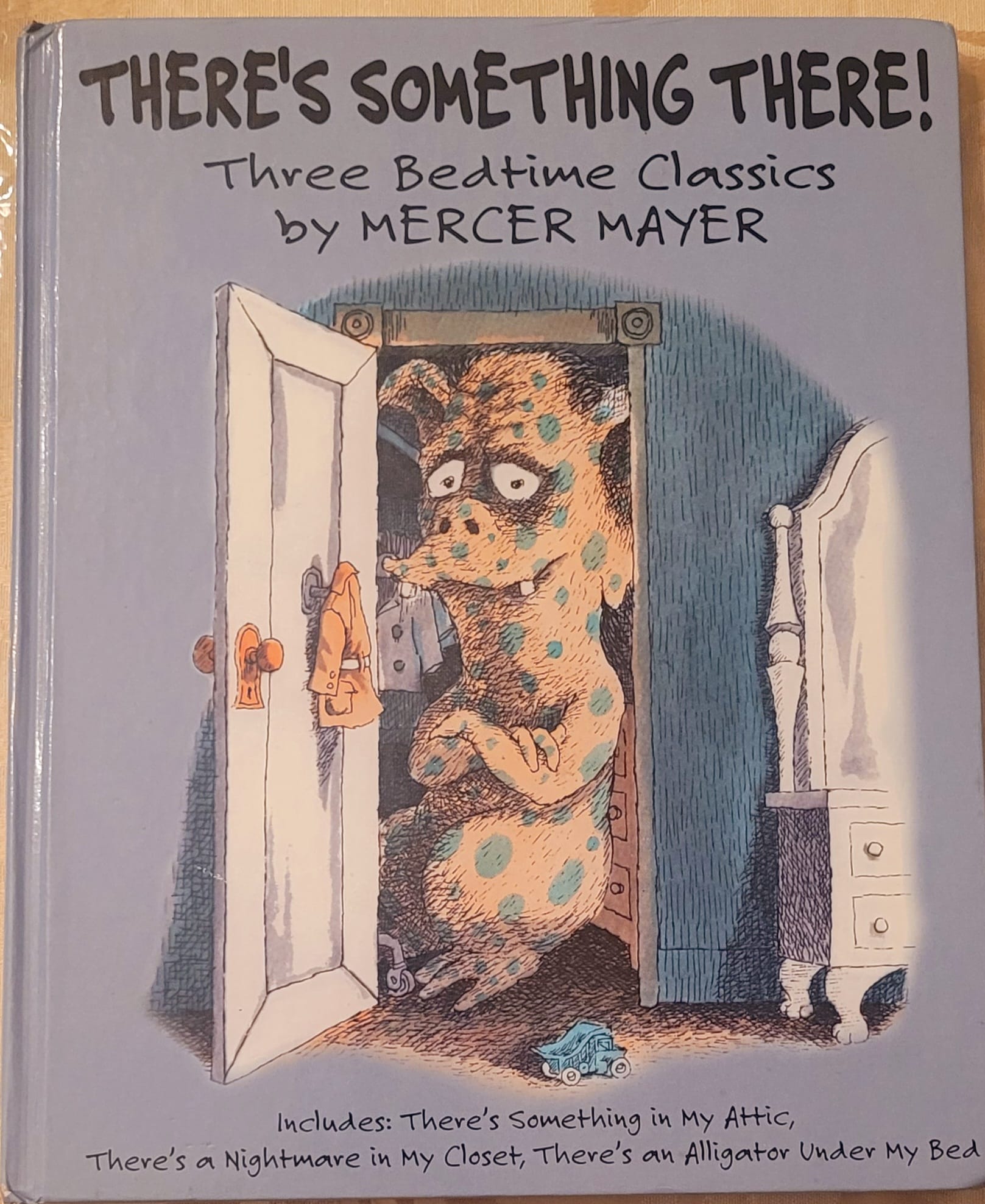 More recently, thanks coming across to a 3-books-in-1 book titled “There’s Something There!” we learned that the Alligator book is part of a set of three similar books, perhaps considered a triptych (not a trilogy) on children dealing with nighttime/bedtime fear. He wrote a much earlier book titled “There’s a Nightmare in My Closet” (1968) and then a year after the Alligator book, he wrote “There’s Something in the Attic.”
All these books are about fear. They all address fears that children have that adults can not see or recognize. In each story the fears are dismissed by the adults, but of course, that alone isn’t helpful to the fearful child. It does nothing to allay his/her fears.
But the three books do differ in how to address those fears, each book has its own approach. While they are children’s books, and the fears are fictional monsters, nightmares and alligators, there can be meaningful messages and life lessons gleaned on how to work on addressing fears in our lives, even the adult fears (which are also often dismissed, ridiculed or simply not recognized by others).
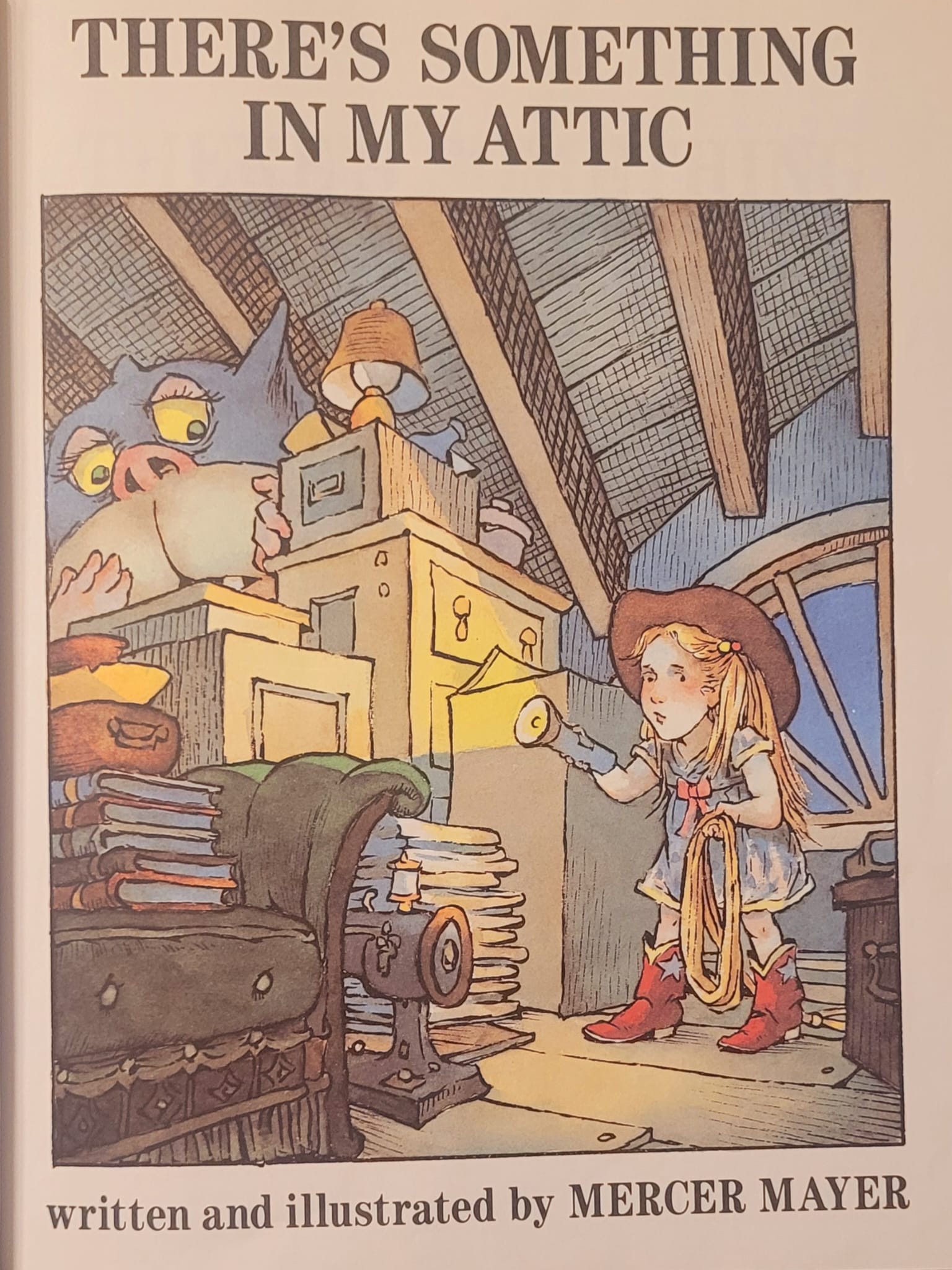 In the “There’s Something in the Attic” (1988) the little girl keeps hearing sounds in the attic. Her parents dismiss her concerns. She finally ventures up – with a lasso in hand, with cowboy hat and boots, and manages to corner and trap the monster up there! She’s eager to bring it down to show her parents, but in the last minute the larger monster slips out of her lasso and is gone. But she still feels somewhat assured that (1) her concerns were valid (2) she got it under control, she had it lassoed, even if just for a little bit!
There’s echoes of Tanya here. You can’t always capture/transform/totally change the problem/your nature etc, but you can keep it in check. That limited sense of control, even if it isn’t permanent, is still something significant, and it makes the problem or fear much more manageable.
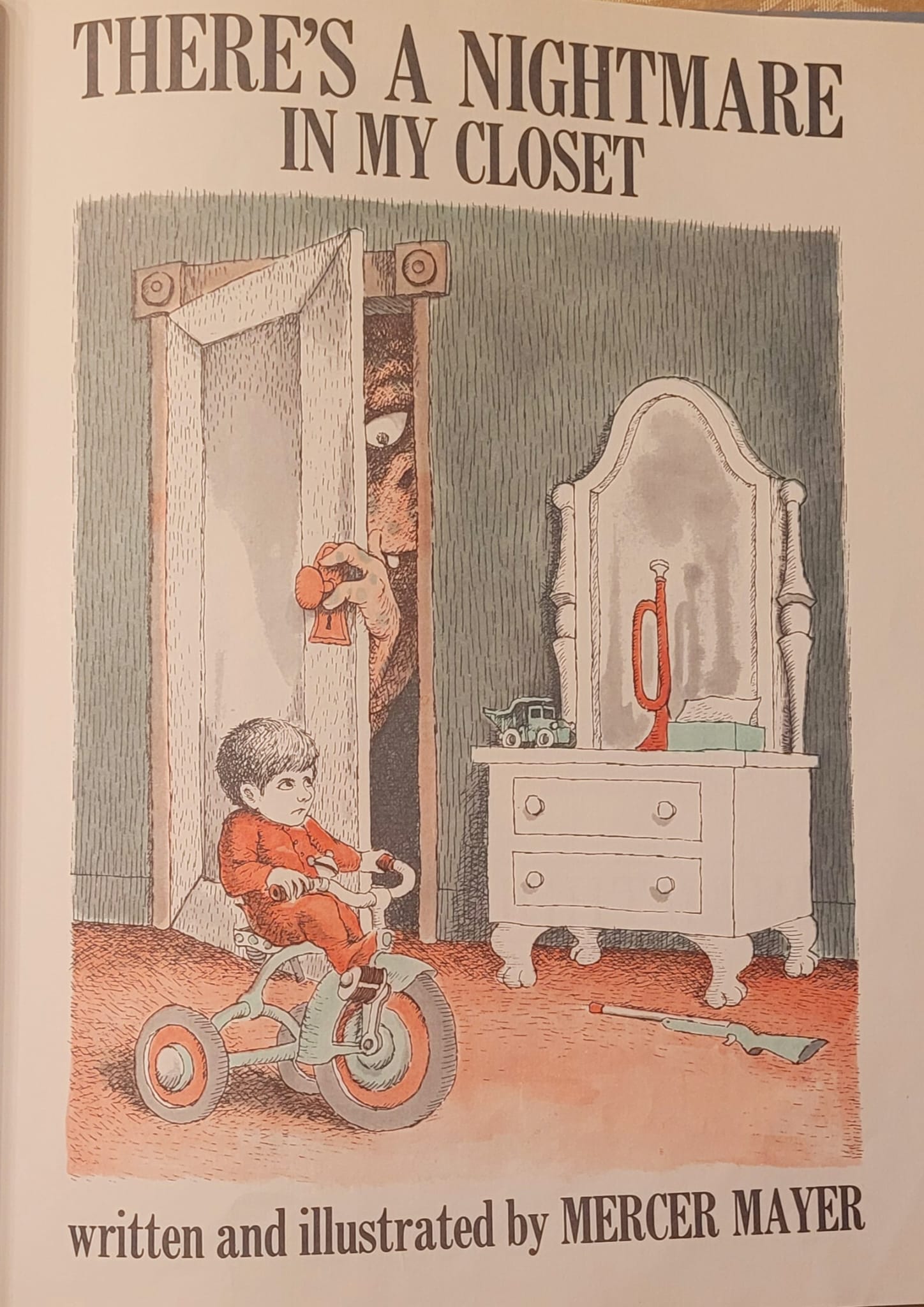 In the book “There’s a Nightmare in My Closet” (1968) the boy in the story is so frightened by the prospect that he uses a toy pop-gun to shoot/scare off the nightmare he fears is lurking in the dark of his closet. But he is surprised and taken by the unexpected cry of the fierce nightmare. The nightmare was afraid of him! His gunshot exposes an unexpected vulnerability, which elicits compassion and connection in the boy in the bed. So much so, that he invites the frightened nightmare to cuddle for comfort in his bed. Imagine that!
But then, near the end of the book, once he’s already (somewhat) comfy in bed with the nightmare, a thought occurs to him that there might be yet another nightmare lurking in the darkness of his closet! But he says aloud that he can handle one nightmare in his bed, but doesn’t have room for two. He knows the extent of his tolerance level, he knows how much he thinks he can handle.
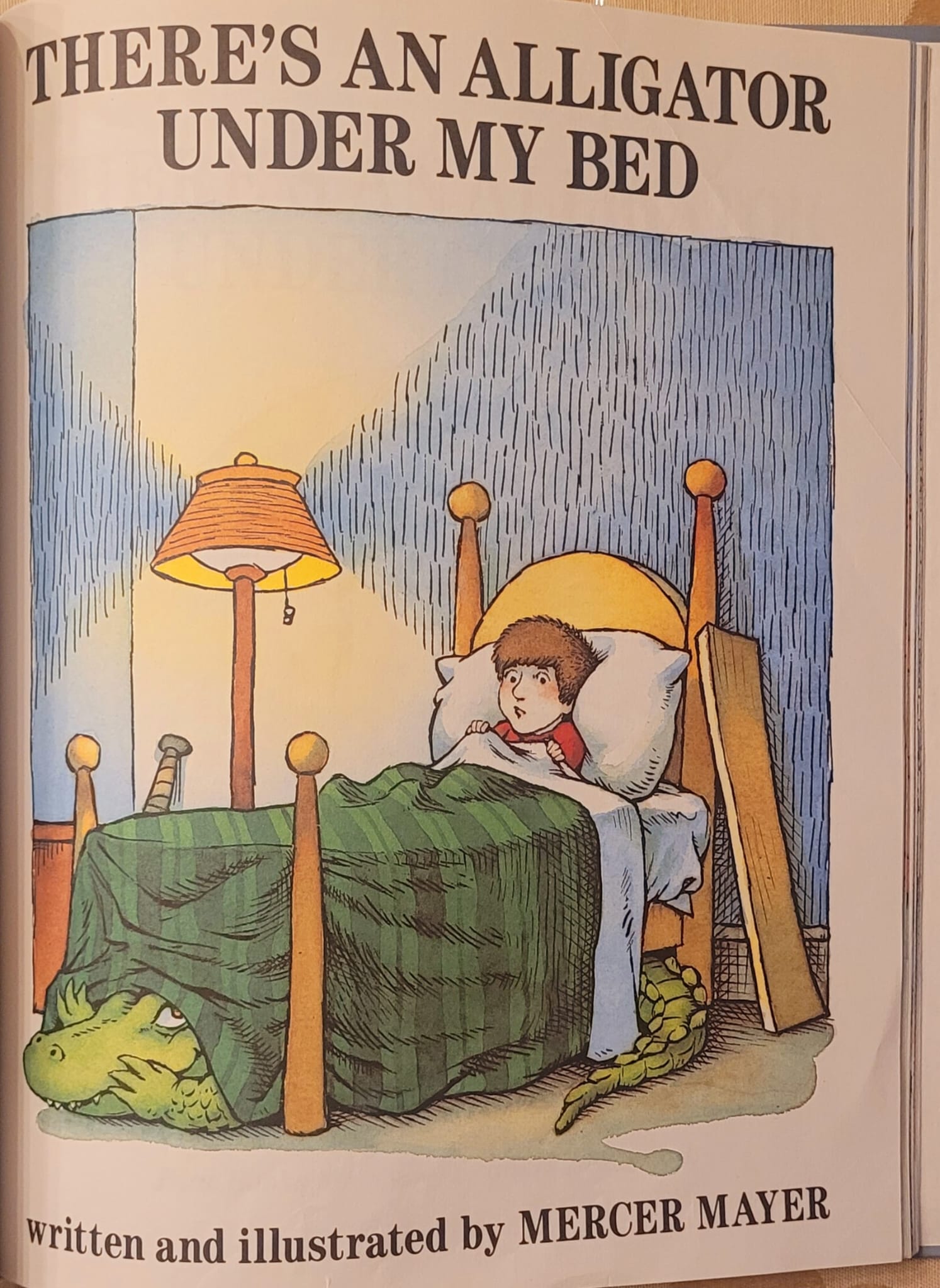 And then the book that was my children’s original favorite of this set, “There’s An Alligator Under My Bed” (1987). Here again, parents dismiss what they consider a ridiculous notion, that an alligator is living under the boy’s bed. But this time the boy takes action. He collects a bag of “alligator bait” and leaves a trail running from under his bed going down the hall, down stairs, and into the garage. The alligator takes the bait, eats all the food and fruit with nothing left to clean-up, and the boy slams the door to the garage. Oh, and then he leaves a caution note for his father.
In the Alligator book the boy takes action. The alligator under his bed is causing his fear and stress, and he does what it takes to get that thing causing the fear to leave and take up residence in the garage instead. Unlike the Attic story, the slamming of the garage door seems final. He got the job done. And unlike the Nightmare story, he’s not inviting the nightmare into his bed, he’s chasing it out, far enough away.
The truth is that not all people are the same, and not all fears are equal. There isn’t a one-size-fits-all solution. But in all three Mercer Mayer books, the adults don’t see the problem, and the child has to deal with it. The fears change slightly between the three books, the methods and approaches vary greatly. But something changes, enough change for the child to be able to sleep!
—
Not sure who put together the 3-books-in-1, but the order there is interesting: It puts the Attic story first, the Nightmare next and the last story is the Alligator.
It’s not chronological – the Nightmare story was written in 1968 and is the middle story placed between the 1987 Alligator and 1988 Attic books. And conceptually, trying to think of how these three methods of dealing with fear might be building on each other? Why this order?